
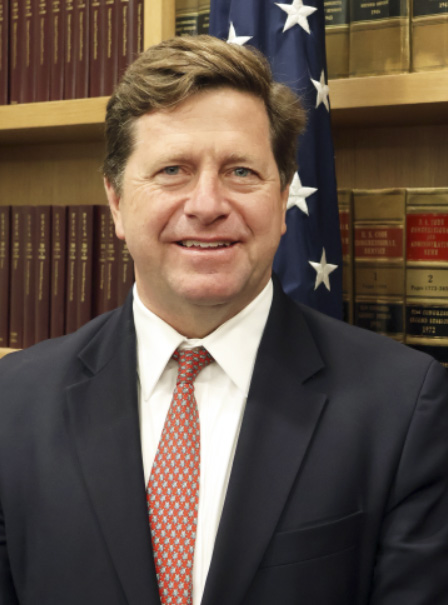
WASHINGTON: President Donald Trump's nominee to lead the US intelligence community said that economic security is inseparable from national security, arguing that America's intelligence agencies must sharpen their focus on China's economic challenge, artificial intelligence and emerging technologies.
Appearing before the Senate Select Committee on Intelligence for his confirmation hearing as Director of National Intelligence (DNI) on Wednesday (local time), Jay Clayton said future intelligence assessments must increasingly account for economic and technological competition alongside traditional military threats.
"National security and economic security are synonymous," Clayton told lawmakers. "National security and market function and market integrity are synonymous. Our financial infrastructure is essential to our security as a nation."
He added that understanding the economic consequences of geopolitical events should become a central part of intelligence analysis.
"Understanding the economic consequences of actions is an essential part of intelligence," Clayton said.
Responding to questions from Committee Chairman Tom Cotton, Clayton agreed that economic competition has become a key front in strategic rivalry with major powers.
"Our adversaries not only look at kinetic and other what I would call traditional ways to harm Americans, they look at economic ways to harm Americans," he said.
Clayton, currently the US Attorney for the Southern District of New York and a former chairman of the Securities and Exchange Commission (SEC), cited his experience dealing with cyber threats, financial markets and sanctions enforcement as preparation for leading the intelligence community. He said intelligence agencies should provide policymakers with better assessments of how economic developments shape national security.
Republican Senator Mike Rounds, who introduced Clayton to the committee, said the nominee's experience extends beyond law enforcement into issues increasingly shaping global security.
Rounds said Clayton's work had given him valuable experience with "cyber threats from state and non-state actors, illicit finance, economic competition with China, and the rapid adoption of artificial intelligence by both our adversaries and our own intelligence community."
Artificial intelligence also featured prominently during the hearing.
Clayton described AI as "a game changer" and warned that it presents both opportunities and risks for intelligence agencies.
"I expect it's the same... that AI is not only an opportunity but a threat. When something's both an opportunity and a threat, you better get your arms around it," he said.
He also pointed to semiconductor export controls as an example of how commercial and national security interests increasingly overlap, recalling cases involving attempts to divert restricted chips to China. He said intelligence agencies should work closely with departments responsible for commerce and technology to address such challenges.
Later in the hearing, Clayton identified Russia, China and Iran among America's principal strategic adversaries, while arguing that economic tools are becoming as important as military capabilities in confronting global threats.
"The economic effects of various events should be more a part of intelligence assessments," he said. "Markets react, and then people react to markets."
The growing US emphasis on economic security comes as Washington seeks to reduce dependence on Chinese supply chains and strengthen partnerships in critical technologies with trusted allies. India has emerged as one of the United States' key strategic partners in semiconductors, advanced manufacturing, artificial intelligence and resilient supply chains under recent bilateral initiatives.
If confirmed by the Senate, Clayton would oversee the US intelligence community's 18 agencies at a time when policymakers increasingly view technological leadership, economic resilience and supply-chain security as central pillars of national security alongside traditional intelligence operations.
--IANS