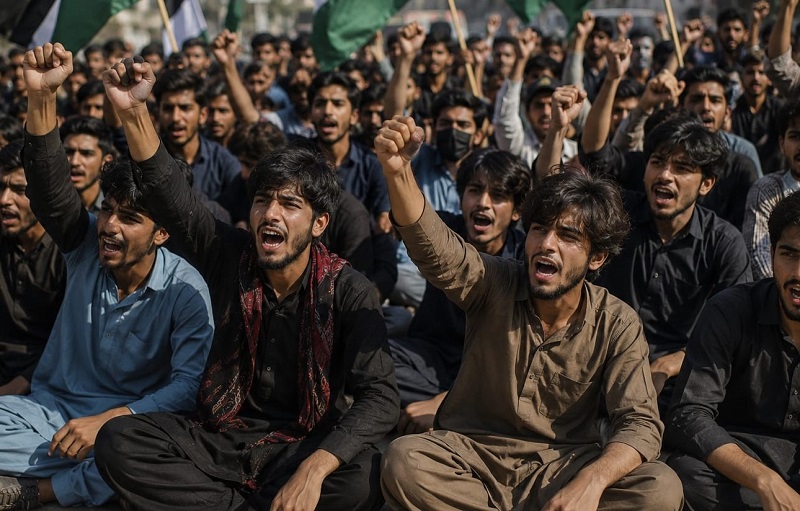
Quetta : Several students staged a peaceful march in Balochistan’s Khuzdar district against the closure of a Digital Library by Pakistani authorities, alleging that the move had disrupted their education and left them with no option but to study along the roadside, local media reported on Friday.
The march drew participation from students, teachers, and local residents who demanded the protection of their fundamental educational rights.
The students alleged that the district administration locked the library’s main entrance following the march and that some participants were mistreated.
As a result of the closure, students were forced to study along the roadside outside the building, a situation they described as “extremely regrettable and concerning”, The Balochistan Post reported.
Calling their campaign entirely peaceful, the students said, “Our only demand is the protection of our legitimate and fundamental educational rights.”
The protestors called on the Balochistan Chief Minister, the commissioner of Kalat Division and other relevant authorities to address the issue, while ensuring the uninterrupted resumption of educational activities at the library.
Warning of a highway protest if their demands were not met, the students said that the district administration would bear responsibility for any consequences resulting from the library’s continued closure.
Condemning the closure of the library, the Baloch Voice for Justice (BVJ) said, “ The eviction of students from Khuzdar Library is a deeply alarming decision. Hundreds of students rely on this public library for studying, exam preparation, research, and academic learning. Denying them access to this vital educational space is an attack on students' right to education. We stand in solidarity with the students of Khuzdar."
This protest comes amid the deteriorating situation of the education sector across Pakistan, including in Balochistan, where inadequate educational infrastructure and limited access to learning facilities continue to undermine students’ rights to education
A recent report highlighted that, two years after Pakistan declared a National Education Emergency, the country continues to face one of the world's worst education crises, with over 25 million children still out of school.
Pakistan’s education crisis is not only about making policy but about implementation, with weak governance structures, fragmented administrative systems, insufficient funding, poor data integration and provincial disparities continuing to hinder progress, leading Pakistani daily The News International reported, highlighting a comprehensive comparative policy review prepared by the Civil Services Academy (CSA).
In the report, Balochistan has been identified as the most structurally disadvantaged province, where deep infrastructural gaps persist despite a reported drop in out-of-school rates from 69 per cent in 2023 to 45 per cent in 2025. Balochistan's vast geography implies that children often need to travel around 30 kilometres to go to primary schools and up to 360 kilometres for secondary education, making regular attendance largely unfeasible in many parts of the province.