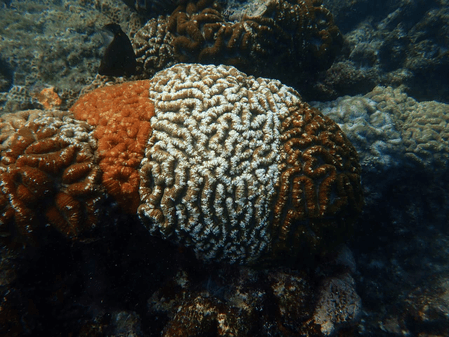
KOCHI: A rare underwater sighting of orange, white, and green corals growing together off Minicoy in Lakshadweep has opened a new window into how coral colonies respond differently to rising sea temperatures, according to scientists at the ICAR-Central Marine Fisheries Research Institute (CMFRI).
The striking formation was photographed by CMFRI research scholar Alvin Anto during a marine mammal survey.
The corals were identified as Lobophyllia corymbosa, seen in vibrant orange, and Lobophyllia radians, displaying white and green hues.
What has particularly intrigued researchers is the contrasting condition of two neighbouring colonies of L. radians.
One has undergone bleaching after losing its symbiotic algae, while the other remains healthy and green despite growing immediately alongside it.
The observation could prove significant for scientists studying why some corals withstand thermal stress better than others.
"This is not merely a symbol of India's rich marine biodiversity. It tells the story of both resilience and vulnerability to climate stress," said CMFRI Director Dr Grinson George.
He said the contrasting response of the neighbouring colonies could provide valuable insights into thermal stress tolerance, with potential applications in coral reef restoration and climate adaptation research.
Coral bleaching occurs when environmental stress, particularly elevated sea temperatures, causes corals to lose their symbiotic algae, which provide them with much of their energy and colour.
Prolonged bleaching can ultimately lead to coral death.
The Minicoy observation therefore offers scientists a natural comparison of two colonies of the same species, growing virtually side by side, yet responding differently to the same environmental conditions.
CMFRI is also stepping up efforts to strengthen marine ecosystems against climate pressures.
With support from the Centre, the institute is scaling up artificial reef deployment along coastal waters to revive degraded habitats, enhance biodiversity and support artisanal fishing communities.
The institute is simultaneously working to replenish depleted marine resources through fish breeding, seed production and sea-ranching programmes.
According to Dr George, restoring natural habitats through artificial reefs can contribute to building more climate-resilient marine ecosystems.
The colourful coral assemblage off Minicoy, meanwhile, has given researchers something more valuable than an unusual photograph: a natural clue to why some corals survive warming seas while others struggle, knowledge that could become crucial as climate change puts coral reefs under increasing pressure.