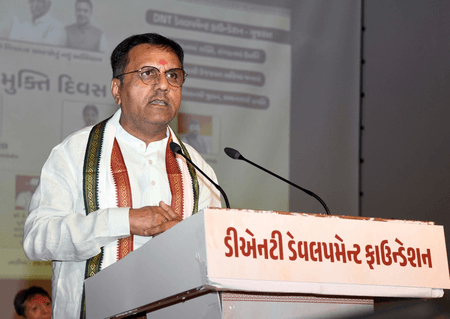
Gandhinagar, Aug 30 (IANS) The Gujarat government has increased its budgetary allocation for the welfare of Nomadic and Denotified Tribes (NT-DNT) to Rs 170 crore for 2026-27, up from Rs 163 crore in the previous financial year, State Social Justice and Empowerment Minister Pradyuman Vaja said at a 'DNT Liberation Day' programme in Gandhinagar.
The programme was organised on Saturday by the DNT Development Foundation at Town Hall to commemorate August 31, observed as DNT Liberation Day, and to raise awareness about the identity, rights and issues of Denotified, Nomadic and Semi-Nomadic communities.
Vaja, who attended the event, said the state government is committed to their overall development and self-reliance.
Referring to Prime Minister Narendra Modi's "Sabka Saath, Sabka Vikas, Sabka Vishwas and Sabka Prayas" and Pandit Deendayal Upadhyaya's principle of 'Antyodaya', Minister Vaja said: "Ensuring development benefits reached the last person in society remained a priority."
He urged parents to focus on their children's education and called upon young people to use mobile phones and the internet to learn new technology, artificial intelligence and digital skills rather than limiting them to entertainment.
The Minister said the state Nomadic and Denotified Tribes Development Corporation provides loans of up to Rs 15 lakh at interest rates of four to five per cent for self-employment.
Its budget allocation has been raised from Rs 12 crore last year to Rs 20 crore for 2026-27.
Under various schemes, term loans ranging from Rs three lakh to Rs 15 lakh and microfinance loans of up to Rs 2.50 lakh are available for small businesses and self-employment.
"The Mahila Samriddhi Yojana provides women loans of up to Rs 2.5 lakh at four per cent, while the New Swarnima Yojana offers assistance of up to Rs five lakh. The New Aakanksha Yojana provides educational loans of up to Rs 15 lakh for higher education," the Minister said.
Minister Vaja added that the state government had also taken measures to ensure students were not deprived of scholarships, including reopening the Digital Gujarat portal three times for applications.
"Under the Pandit Deendayal Upadhyaya Awas Yojana, homeless families receive plot allotments and Rs 1.70 lakh through direct benefit transfer for house construction," he emphasised.
He said that caste certificate procedures had been simplified, with instructions to issue certificates within seven days where appropriate documents were submitted.
"Applicants whose requests were rejected could appeal before the Prant Officer, Collector and Analysis Committee," he noted.
Minister Vaja also administered five pledges for building a developed society: ensuring education for every child; providing young people with skill-development and employment opportunities; ensuring direct access to welfare schemes for every family; guaranteeing quality education, safety and self-reliance for every girl; and ensuring dignity for every citizen while working towards social reform.
Pravin Ghuge, a member of the Development and Welfare Board for Nomadic, Denotified and Semi-Nomadic Tribes, said the occasion should go beyond celebration and focus on providing communities permanent relief from social and economic difficulties.
"A specialised board for their welfare and development was constituted in 2019 under Prime Minister Narendra Modi's leadership and that efforts were being made to provide permanent housing and addresses through schemes, including the Pradhan Mantri Awas Yojana," he added.
K.G. Vanzara, former Additional Secretary of the State Social Justice and Empowerment Department, said communities also needed to accept responsibility for their own development rather than relying solely on the state government.
He called for an end to addictions, superstition and harmful customs, and said education, employment and housing should be treated as key pillars of development.
DNT Development Foundation Chairman Bharat Patani said the organisation aimed to expand its work to 16 states and more than 300 districts and launch one lakh service projects.
"More than 7,000 women's self-help groups had been activated through the Central government's SEED scheme and revolving fund, with basic facilities such as drinking water and hand pumps provided in rural areas including Kodinar and Manavadar," he added.
August 31 is observed as DNT Liberation Day to mark the post-Independence denotification of communities that had been classified as "criminal tribes" under the British-era Criminal Tribes Act.
--IANS
mys/khz